

Planning a road trip with the family should feel exciting, not nerve-wracking. Yet many families set off without realising that 55% of drivers skip tyre pressure checks before departure, increasing the risk of preventable accidents near home. The reassuring truth is that most road trip incidents are avoidable with a little preparation and a few smart habits. This guide walks you through every essential safety measure: from vehicle inspection and defensive driving, to protecting your children, managing extreme weather, and building an emergency kit that actually works when you need it most.
Table of Contents
- Start with a thorough vehicle and route check
- Defensive driving and safety habits on the road
- Special considerations: weather, terrain and remote areas
- Family safety essentials: children, seating and emergency readiness
- Our take: the most overlooked family road trip safety hazards
- Equip your family for a safer road trip
- Frequently asked questions
Key Takeaways
| Point | Details |
|---|---|
| Be proactive with checks | Check tyres, fluids, and emergency gear before leaving to avoid the most common causes of breakdowns and accidents. |
| Defensive habits protect families | Always use seatbelts, avoid distractions, and match your speed to road conditions for safer travels. |
| Manage for weather and terrain | Stay aware of forecasts and bring extra supplies when travelling through rural or extreme environments. |
| Prioritise child safety always | Children should use age-appropriate seats and ride in the back, with emergency kits accessible for all. |
| Rest and regular breaks matter | Taking breaks and avoiding fatigue are vital for alert driving and enjoyable family trips. |
Start with a thorough vehicle and route check
With an understanding of how overlooked basics cause problems, let us begin where every safe road trip starts: vehicle and route preparation. Before a single bag is loaded into the boot, the car itself needs your full attention. A pre-trip inspection takes roughly 30 minutes and can prevent the kind of breakdowns that strand families on motorways or in unfamiliar areas far from help.
Here is a quick overview of what to check and why each item matters:
| Check | What to look for | Why it matters |
|---|---|---|
| Tyre pressure and tread | Match manufacturer’s recommended PSI; check for uneven wear | Low pressure and worn tread increase blowout risk |
| Brakes | Listen for squealing; check brake fluid level | Worn brakes extend stopping distance significantly |
| Engine fluids | Oil, coolant, windscreen wash, power steering | Low fluids can cause engine damage or poor visibility |
| Lights | All exterior and interior lights working | Essential for visibility in tunnels, rain and at night |
| Emergency supplies | Torch, warning triangle, first aid kit, spare tyre | Required in many European countries by law |
The tyre check deserves special attention. Despite being one of the simplest checks imaginable, the tyre pressure risk is very real: 55% of drivers skip it, and underinflated tyres overheat under load, especially in summer on long motorway stretches. Check pressure when tyres are cold, before you drive. Use the figures in your vehicle handbook or on the sticker inside the driver’s door, not what is printed on the tyre itself.
Route planning is just as important as vehicle readiness. Plug your destination and waypoints into a navigation app, but also download offline maps in case signal drops. For remote or rural stretches, a paper map is genuinely useful. Always share your planned itinerary with someone who is not travelling with you: include your route, estimated arrival time and key stops. If something goes wrong and you cannot make contact, that person knows where to look. For mountain passes, coastal roads or areas with limited coverage, consider a satellite communicator device.
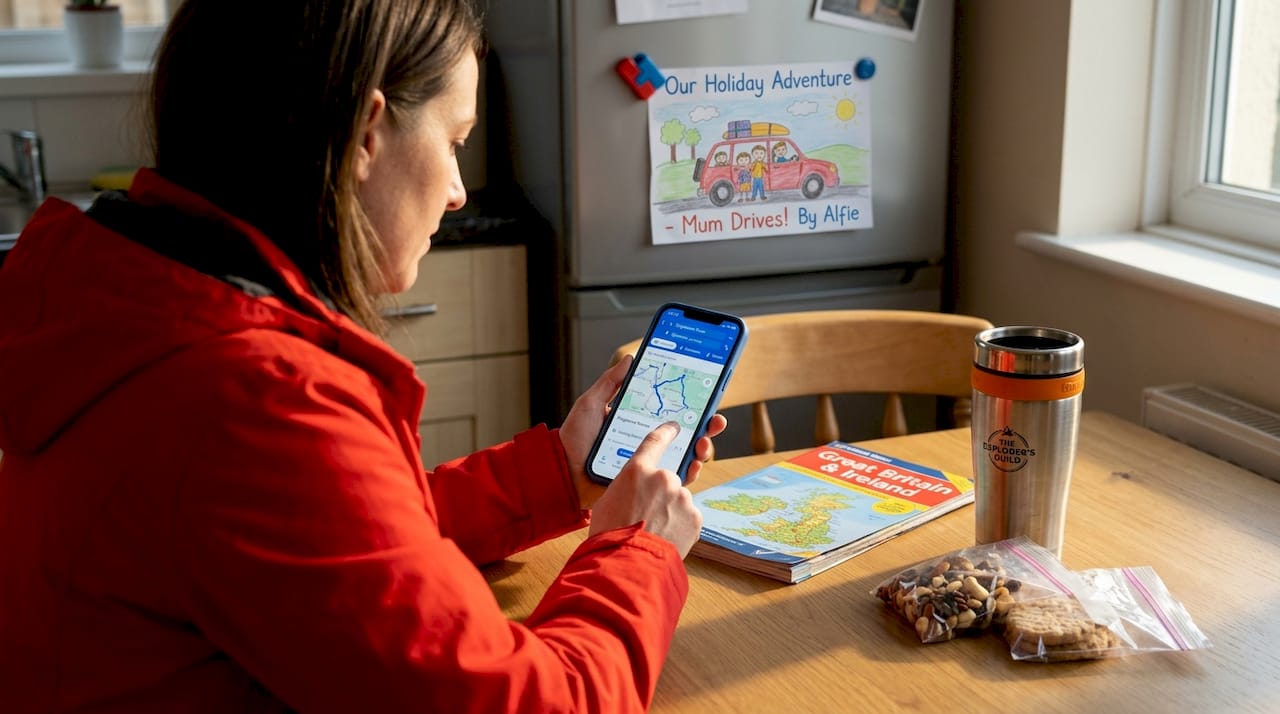
A solid vehicle preparation guide will cover much of this in detail. For families who want to think beyond the basics, exploring the right gear for safe trips makes a real difference in peace of mind.
Pro Tip: The night before departure, place your vehicle documents, insurance certificate and roadside assistance contact number in a single clear wallet in the glove box. Stressed parents searching through bags in an emergency can waste critical minutes.
Defensive driving and safety habits on the road
With the car and route prepared, next is adopting habits that protect everyone every minute on the move. The way you drive has a greater effect on road trip safety than almost any gadget or accessory. Evidence consistently backs this up.
Seatbelt use reduces fatal injury risk by 45%, and 1 in 5 accidents result from driver distraction. These are not abstract statistics: they describe real families on ordinary journeys.
Defensive driving is a recognised technique used by professional drivers worldwide. It means staying aware of your surroundings, anticipating the actions of other road users, and giving yourself enough time and space to react. Here are the core habits to practise:
- Always use seatbelts. Every passenger, every journey, no exceptions. Children should be in age-appropriate car seats or booster seats and secured correctly before the engine starts.
- Keep your phone away. Set it to do-not-disturb before you pull out of the driveway. Even hands-free calls reduce concentration. If you need to make a call, stop safely first.
- Maintain a safe following distance. The two-second rule (more in wet or icy conditions) gives you time to react if the car ahead brakes suddenly. Many families underestimate how much stopping distance increases with speed.
- Scan continuously. Skilled drivers look 12 to 15 seconds ahead, not just at the bumper in front of them. This early awareness of hazards, merging traffic or pedestrians gives you a crucial buffer.
- Observe speed limits, always. Speeding accounts for 29% of long-trip fatalities, making it one of the single biggest killers on extended journeys. Speed limits are not suggestions: they are set based on road design, traffic density and risk assessment.
- Adjust for conditions. Rain, fog, strong winds and road surfaces all demand you slow down. Legal speed limits assume dry, clear conditions. When visibility drops or the road is slippery, reduce speed accordingly.
The comparison below shows just how much a few habit shifts can change your risk profile on the road:
| Risky habit | Safer alternative |
|---|---|
| Driving with phone in hand | Set phone to silent; use a mount for navigation only |
| Tailgating on motorways | Maintain 2-second following distance; 4 seconds in rain |
| Ignoring seatbelt for short trips | Buckle up for every journey, even 5 minutes from home |
| Driving through the night without breaks | Stop every two hours; swap drivers when possible |
| Speeding to make up time | Allow extra time; arriving late beats not arriving |
Complement these habits by reading our long-distance driving tips before a big trip. Fatigue is one of the most underestimated threats on long drives, so understanding how to manage it is vital. Our guide on managing travel fatigue explains the warning signs and what to do when they appear.
Special considerations: weather, terrain and remote areas
Even the best routines are tested by changing conditions. Here is what to do when the weather, terrain or distance brings extra risks.
Weather is unpredictable, and most families do not check detailed forecasts for every part of their route, only the destination. A storm can be completely absent at your hotel but dangerous 80 kilometres from it on a mountain pass. Before you set off, use a weather service that covers your entire route, not just start and finish points. If severe weather is forecast, genuinely consider delaying. No beach, theme park or family reunion is worth a preventable tragedy.
Flooding is particularly dangerous and frequently underestimated. Six inches of water can stall most cars, and water deeper than that can move a vehicle off the road entirely. Never attempt to drive through standing or moving flood water, even if other vehicles seem to manage. Roads beneath floodwater are invisible: there may be debris, potholes or collapsed surfaces you cannot see. Turn around and find an alternative route, or wait for conditions to improve.
Here is a practical checklist for remote and rural travel:
- Satellite communicator or personal locator beacon. Mobile signal disappears on rural roads. These devices can summon help anywhere.
- Printed maps. Apps fail. Batteries die. A paper map of your route costs nothing and weighs almost nothing.
- Extra drinking water. Carry at least two litres per person beyond what you plan to consume. Breakdowns in heat are dangerous without it.
- A good torch with fresh batteries. Changing a tyre or reading a map in the dark is a safety issue without one.
- High-visibility jackets for every occupant. In many European countries, these are legally required when exiting the vehicle on a road.
- Extra clothing and a blanket. If you break down in a cold or wet area and help is hours away, staying warm is essential.
A few other hazards are worth naming directly. Never leave a child, elderly person or animal in a parked car in warm weather. On a sunny day with the windows closed, the temperature inside a car can rise by 11°C in just ten minutes and can reach lethal levels within 30 minutes. This risk is real and well-documented, yet incidents still occur every summer.
For packing guidance tailored to longer or more remote journeys, the expert packing for remote routes article covers practical organisation and the specific items experienced travellers rely on.
Pro Tip: Pack snacks that do not require refrigeration, a power bank for each device, and a small blanket per person. Unexpected delays on rural roads can stretch from an hour to overnight.
Family safety essentials: children, seating and emergency readiness
The final piece: making sure every member of the family, especially the youngest, has what they need to stay safe every mile.
Child safety on the road starts with the seat. Children should ride rear-facing as long as possible, and all children under 13 belong in the back seat. Rear-facing seats distribute crash forces across the whole back, neck and head rather than concentrating them on the neck alone. When children outgrow rear-facing seats, forward-facing seats with a harness come next, followed by booster seats. Each transition should happen based on the child’s weight and height, not their age. Instructions are printed inside every car seat box and are worth reading carefully.
Here are the must-dos for child-friendly car safety:
- Fit the car seat correctly every time. An incorrectly fitted seat offers very little protection. Many councils and charities offer free car seat checks.
- Check the harness is snug. You should not be able to pinch fabric at the shoulder straps.
- Never place a rear-facing seat in front of an active airbag. This is a known and preventable cause of serious child injury.
- All adults must wear seatbelts. An unbelted adult in a crash becomes a high-speed projectile that can injure other passengers, including children.
Alongside seating, every family car should carry an accessible emergency kit. The table below outlines what to include:
| Item | Purpose |
|---|---|
| First aid kit | Treat minor injuries until help arrives |
| Drinking water (at least 2 litres) | Hydration in breakdowns or delays |
| Non-perishable snacks | Energy for children during unexpected waits |
| Torch with spare batteries | Safety in darkness; signalling |
| Reflective warning triangle | Alert other drivers if broken down |
| Mobile phone charger or power bank | Keep devices operational for calls or navigation |
| Blanket | Warmth during overnight delays |
| Medical information cards | Vital for each family member in a medical emergency |
Teach your children, from a young age, what to do if something goes wrong. They should know their full name, your mobile number, and that they should stay near the vehicle if you break down in a safe location. Older children can learn how to call 112, the universal emergency number across Europe.
For more guidance on keeping children comfortable and secure, the child road trip safety article covers practical strategies that make long journeys genuinely enjoyable.
Pro Tip: Keep a small, sealed envelope in your glovebox for each family member containing their name, allergies, blood type and any regular medication. In an emergency, this can be handed to a paramedic instantly without searching through phones.
Our take: the most overlooked family road trip safety hazards
After years of time on the road and working closely with families who travel regularly, we have noticed a pattern. Most families invest in the visible stuff: good sat-nav, roof boxes, travel games for the children. What they neglect is far less glamorous but far more consequential.
Rest is the greatest safety tool you have, and it is the most routinely sacrificed. The plan said you would stop every two hours. Then one child falls asleep, traffic is lighter than expected, and you push on. Then you push on a little more. This is how fatigue-related accidents begin: not dramatically, but incrementally.
Calm communication inside the car matters too. When something goes wrong, whether it is a missed exit, a sudden downpour or a child who is carsick, families who have a calm, pre-agreed plan handle it safely. Those who panic and react suddenly are the ones who swerve into the wrong lane. We write about expert comfort strategies because the emotional atmosphere inside a vehicle directly affects the driver’s focus.
The habit beats the gadget, every time. A family with a solid routine, regular stops, and everyone in a seatbelt is safer than one with a boot full of expensive equipment and no plan. If you want to understand what experienced road travellers have learned the hard way, reading real travel experiences from people who live this life is far more useful than any checklist.
Equip your family for a safer road trip
Proactive planning and smart habits dramatically reduce risk, and having the right safety equipment on board gives your family an important extra layer of protection.

At Convoy, we have been outfitting families and professional drivers since 1991, and we know that the right gear genuinely matters. A reflective safety harness ensures every member of your group is visible at the roadside, day or night. Our high-visibility safety vest meets European road safety standards and is compact enough to keep in every door pocket. Browse our full range of family travel safety gear and make sure your next journey is as secure as it is memorable.
Frequently asked questions
What is the most common cause of family road trip accidents?
Distraction and skipped vehicle checks are the leading causes: 1 in 5 accidents result from distraction, and 55% of drivers skip tyre pressure checks before departure.
How do I ensure my children stay safe in the car?
Use rear-facing car seats for as long as possible, and keep all children under 13 in the back seat with their seatbelts or harnesses properly fastened at all times.
What should I do if I encounter severe weather during a road trip?
Delay travel where possible and never drive through floodwater, as six inches of standing water is enough to stall most cars and compromise your control entirely.
What are the must-have items for a family road trip emergency kit?
Pack water, non-perishable snacks, a torch, a first aid kit, a power bank, a reflective warning triangle, and a blanket to cover unexpected delays or roadside incidents.
Why is rest important during long road trips?
Fatigue progressively reduces reaction time and decision-making ability, and travel fatigue is a significant contributing factor to accidents on extended journeys. Stop every two hours and swap drivers when you can.