

If you love trucks and movies as well, you’re in the right place, because we’ve brought you the perfect crossover. In our three-part subjective recommendation series, we’ve collected 15 of our favorite trucking movies that we wholeheartedly recommend for a dull evening spent on a break.
In the previous part, we covered the classics of the ’70s, and now we jump to the ’80s. From this decade, we’ve brought you four works from different parts of the world.
Lights off, popcorn in hand, and let the screening continue.

Maximum Overdrive (Maximum Overdrive, 1986.)
A Stephen King story combined with AC/DC’s music is guaranteed to succeed. Or is it?
In 1987, Earth passes through the tail of a comet, which leads to inexplicable consequences. For example, machines come to life—everything powered by electricity turns against humanity and tries to kill them. Toasters turn on by themselves, steamrollers run over people, and trucks set off on their own. Our heroes become trapped in the Dixie Boy Truck Stop. They try to find a way out, but more and more trucks gather at the location—led by a Green Goblin-faced White Western Star 4800—and terrorize them. Anyone who tries to escape is mercilessly run over.
The core idea is quite interesting and perhaps more relevant today than ever, as we are surrounded by electronic devices and artificial intelligence. That’s why it’s unfortunate that the film clearly competes in the B-movie category.
Stephen King not only wrote but also directed the film (and even appears briefly as an actor). However, it’s no coincidence that this first directing effort was also his last. AC/DC’s music helps a lot with the otherwise dull story, but it can’t save the film on its own. At times, the events become almost parodic, making it hard to take seriously or get immersed in. With a bigger budget and a more experienced director, much more could have been made of the concept. When asked why he never directed another movie, King reportedly replied—showing notable self-criticism—“Just watch Maximum Overdrive.” Despite its silliness, truck enthusiasts will still find plenty to enjoy in the many different truck types featured in the film.

The truck
The Green Goblin, leader of the living truck fleet, is actually a White Western Star 4800 from 1976. The company itself was founded relatively late, in 1967, due to differing truck demands between the western and eastern U.S. regions. The focus was on performance and weight reduction for western and midwestern needs. The version featured in the film had a 9.3-liter V8 Detroit Diesel 8V-71 engine, producing 318 HP naturally aspirated or 385 HP with a turbo. Today, very few Western Star 4800 tractors from this era remain on U.S. roads, as most were converted into dump trucks or mixers before being retired.

Over the Top (Over the Top, 1987.)
Although arm wrestling takes center stage, truckers will still find interesting aspects in this film.
Sylvester Stallone’s character drives an old Autocar truck across the country while preparing for an arm wrestling championship—where the grand prize is a brand-new Volvo White WIM 64T tractor. Many truckers can relate to his dream of achieving the freedom of running his own transport business. Meanwhile, he must take care of his estranged son, bringing out the emotional struggles and sacrifices truckers face when being away from family. The child may seem annoying at times, but it serves the story—best to overlook it.
Like many ’80s films, the twists and ending are predictable, yet the film is engaging enough to keep viewers invested. Truck lovers will enjoy the scenic shots of trucks rolling through the southwestern U.S. at sunset, while Giorgio Moroder’s fantastic music enhances the overall experience. Though Stallone was in peak shape after the Rocky films, it’s striking how small he looks next to real arm wrestling competitors.

The truck
Stallone’s old, rusty Autocar A-10264 truck may be worn by time, but it’s clear how much care he puts into maintaining it—it’s everything to him. This 1965 model likely featured an inline-six Cummins diesel engine producing around 200–300 HP, although rumors suggest a Detroit Diesel sound was used in the film. A unique feature was its aluminum cab body.

Roadgames (Roadgames, 1981.)
Let’s switch continents—this time heading to the Southern Hemisphere. Australia, where trucks have bull bars so massive that even a herd of cattle couldn’t damage them.
Stacy Keach plays a truck driver traveling endless, desolate Australian roads with his dog—more precisely, a dingo. Along the way, he encounters a suspicious van driver. All signs point to him being a serial killer targeting hitchhikers, although there’s no proof.
Initially, it’s more of a mental game for the protagonist. His internal monologues, dilemmas, and conversations with his dingo perfectly reflect the loneliness of a trucker’s daily life. Later, he picks up a hitchhiker (Jamie Lee Curtis), and together they try to uncover the connection between the van driver and the murders.
Unlike typical films, the protagonist constantly questions whether he should get involved or just focus on his job—a very realistic approach compared to most American movies. As the story progresses, suspicion shifts onto him, and even the police begin chasing him. This becomes the real “game” (as the original title suggests), as the trucker tries to prove the van driver’s guilt while the latter shifts suspicion onto him—successfully.
The pacing is well structured. The film starts by building character depth, then gradually increases tension. The reappearance of side characters in strange situations adds a surreal touch. There are nods to the classic Duel, and the barren roads hint at the apocalyptic tone later seen in Mad Max. While hitchhikers are rare today, this film is still worth watching for any truck enthusiast.

The truck
The main vehicle is a well-known Mercedes NG 2224 in a 6x4 configuration. It was available with two major engines: a 9.6-liter V6 (192–313 HP) and a 12.8-liter V8 (256 HP). Considering Australian conditions, the latter is more likely.

T.I.R. (1987.)
This entry differs from the others as it’s a 12-episode series. Premiering in 1987, it inspired many viewers—some truckers today even say it influenced their career choice.
As the title of this Italian-Hungarian co-production suggests, the two main drivers (Franco and Vanni) transport unusual cargo across international routes (including a live elephant), while getting involved in unique adventures in every episode. While it’s not as action-packed as Cobra 11, there are still explosions, shootouts, kidnappings, and smuggling scenes. It would definitely deserve a modern remake, especially with today’s advanced filming techniques.
Looking back from today, some scenes are unbelievable—like driving a diesel truck across the Chain Bridge, occupying two lanes with an Iveco on Teréz Boulevard, or parking a truck in Moscow’s Red Square. There are also forest mishaps, parachuted vans, and even participation in the Paris-Dakar Rally. Not to mention scenes featuring Hungarian trucks like Rába models.
The stories are diverse, but all capture the Western sense of freedom that was once just a dream in Hungary. The focus, however, remains on the iconic red Iveco TurboStar known as the “Red Crab”.

The trucks
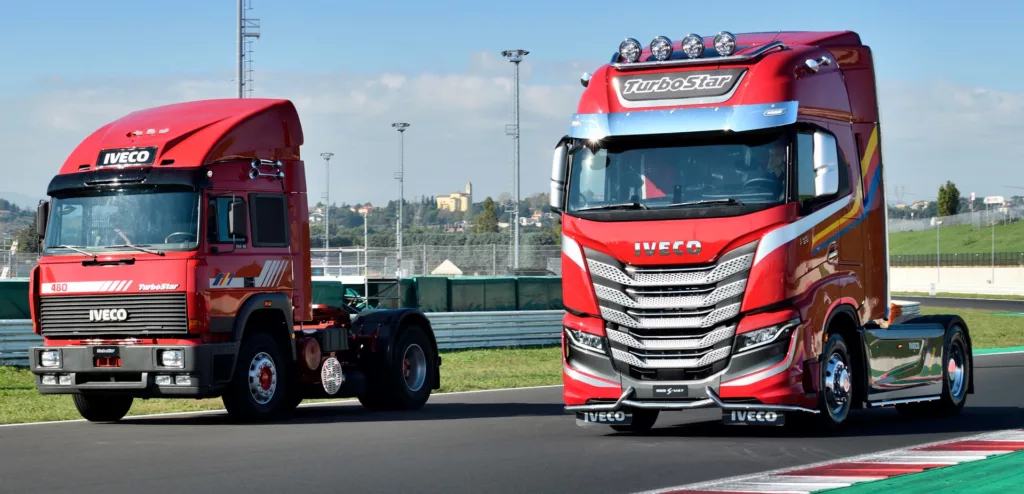
The Iveco TurboStar, introduced in 1984, was designed with ergonomics and performance in mind. Its cab shape was tested in Fiat’s wind tunnel, achieving a drag coefficient of 0.53 with a roof deflector. Comfort features included electric mirrors, air-suspended seats, and a built-in fridge. It came with two diesel engines: a 14-liter inline-six (330 HP) and a 17-liter V8 (420 HP with turbo), the latter being featured in the film. In 2021, Iveco paid tribute with a limited-edition modern S-Way TurboStar version.
In the third and final part of our series, we’ll bring you trucking films from the ’90s and beyond. Don’t miss it to get the full picture.