

Transport is a profession where safety is extremely important. For this reason, there are rules that companies involved in transportation must follow not only to protect the cargo and the vehicle, but also the physical safety of the driver. These include, among others, regulations concerning fire extinguishers, from which no truck driver, carrier, or freight forwarder is exempt.

But what rules exactly apply to fire extinguishers? What type of device should we keep in the vehicle to ensure both safety and compliance, while avoiding penalties?
In this article, we have collected the essential information that transport companies, entrepreneurs, and drivers must know about owning and using fire extinguishers.

Basic data of fire extinguishers: what do we absolutely need to know?
A fire extinguisher is a fire protection device from which the extinguishing agent inside can be directed onto a fire under internal pressure. With the help of a fire extinguisher, the fire can be extinguished and the danger eliminated.
If we need a fire extinguisher, there are several types to choose from. First, it is important to determine what size device we need in accordance with current regulations and standards.
A portable fire extinguisher is a device that can be operated by hand and carried manually, with a maximum weight of 20 kg in operational condition. A mobile fire extinguisher, on the other hand, has a total weight exceeding 20 kg, is movable by hand, and has a maximum nominal charge of 150 kg or 150 liters.
There are also so-called non-standard (large-scale) fire extinguishers and mobile fire extinguishing systems, which have a nominal charge exceeding 150 kg of powder, 150 liters of water-based agent, or 50 kg of carbon dioxide.

In addition to size, every fire extinguisher has a standard classification that helps determine what types of fires it can extinguish. This information can be found on the label on the cylinder, where extinguishing performance and usage instructions are also indicated. This classification has 3 categories, characterized by the following test fires:
- Class A: extinguishing a fire made of stacked pine logs with 10–15% moisture content
- Class B: extinguishing a tray fire consisting of 1/3 water and 2/3 gasoline after one minute of pre-burning
- Class C: extinguishing a fire created by igniting gas flowing from a pipe connected to a 33 kg propane-butane cylinder
Classification of fire extinguishers by extinguishing agent
Different types of fires require different types of fire extinguishers. Therefore, fire extinguishers can also be grouped according to the extinguishing agent used. Based on this, we distinguish the following types:
- Water extinguishers: suitable for fires involving solid materials. Some can be used up to 1000 V electrical voltage.
- Foam extinguishers: suitable for solid, liquid, and liquefied solid material fires. Particularly effective for rubber and plastic fires. Some types can also be used for oil and fat fires. Certified models can be used under electrical voltage up to 1000 V.
- Powder extinguishers: among the most popular types on the market, partly due to their affordability. “BC” powder is mainly suitable for flammable liquids and gas fires, while “ABC” powder can also extinguish solid materials that burn with flames and embers. Usable up to 1000 V. Use with caution, as it may cause damage and secondary issues.
- Carbon dioxide (CO2) extinguishers: suitable for liquid and gas fires. One of the best options for electrical fires, usable up to 30 kV. CO2 is a clean extinguishing agent and does not damage equipment, unlike powder extinguishers. However, it must be used with caution in enclosed spaces.

What should we know about different fire classes?
Combustible materials are classified into different fire classes based on their properties. These classes are обозначены using the letters ABC as follows:
-
- Class A: fires of solid organic materials
- Class B: fires of liquids or liquefied solids
- Class C: fires of flammable gases
- Class D: fires of metals
- Class F: fires of oils and fats

What does the extinguishing performance of fire extinguishers mean?
On every extinguisher label, there is a number-letter combination indicating extinguishing performance. This is a mandatory specification provided by manufacturers and usually indicates the minimum performance. But what does it mean exactly?
Take the example of a 55A 233B C fire extinguisher. The letters indicate the fire classes it can handle. In this case, 55A means the length of the test fire—the extinguisher successfully put out a 5.5-meter (550 cm) wood stack fire. Essentially, multiply the number before the letter by ten to get the fire length in centimeters.
The 233B means that the extinguisher was able to extinguish 233 liters of a heptane-water mixture. Here, no calculation is needed—the number directly indicates the volume.
Finally, there is no number next to the C rating because for gas fires, only suitability is tested. If the C marking is present, it means the extinguisher is suitable for gas fires.

What is a 6 kg fire extinguisher sufficient for?
The effectiveness of an extinguisher depends on several factors, mainly the extinguishing agent and pressure. Modern devices can have up to double the performance with the same amount of agent, so smaller size does not necessarily mean lower efficiency.
While a 2 kg powder extinguisher is sufficient for passenger cars, larger vehicles require bigger units because cargo must also be considered.
1 piece of 6 kg ABC powder extinguisher is sufficient for vehicles between 3.5–12 tons, while above 12 tons, at least 1 piece of 12 kg or 2 pieces of 6 kg ABC extinguishers are required.
What fire extinguisher must be kept in a truck?
For passenger cars, two 2 kg ABC powder or 2-liter foam extinguishers are recommended, while for light commercial vehicles, 6 kg ABC extinguishers are advised.
For trucks and road vehicles, the required quantity depends on total weight:
- over 3,500 kg up to 12,000 kg: at least 1 piece of 6 kg
- over 12,000 kg: at least 1 piece of 12 kg or 2 pieces of 6 kg
The extinguisher must be suitable for class A, B, and C fires and comply with standards.
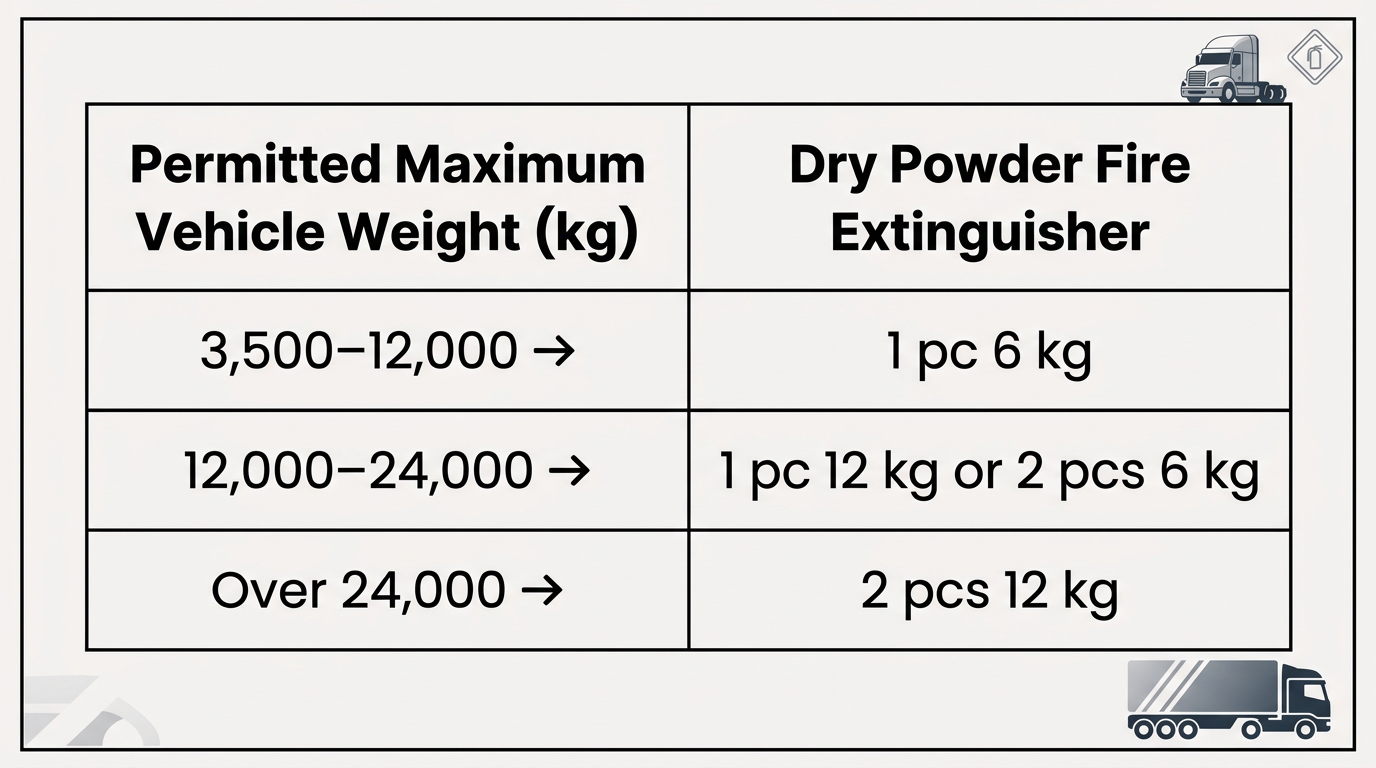
Vehicles transporting hazardous materials must comply with ADR regulations, requiring at least the above-mentioned extinguishers.
For agricultural machinery, a 6-liter foam extinguisher is often more effective than powder extinguishers.

Transport and storage of fire extinguishers
Proper mounting is essential. Fire extinguishers must always be easily accessible and positioned so they can be used as quickly as possible even in the worst-case fire scenario.
Powder extinguishers must be stored vertically or within a 15-degree angle from vertical.
They should be secured using appropriate mounting brackets or storage boxes to ensure stability during transport.
In the Convoy.hu webshop, you can find holders that help secure extinguishers safely and in compliance with regulations.
Maintenance of fire extinguishers
Many people think purchasing an extinguisher is enough, but regular maintenance is essential. Poorly maintained extinguishers are unsafe and can also result in fines.
Maintenance is mandatory annually and includes basic, intermediate, and full service depending on the device’s age.
Maintenance must be performed only by certified service providers.
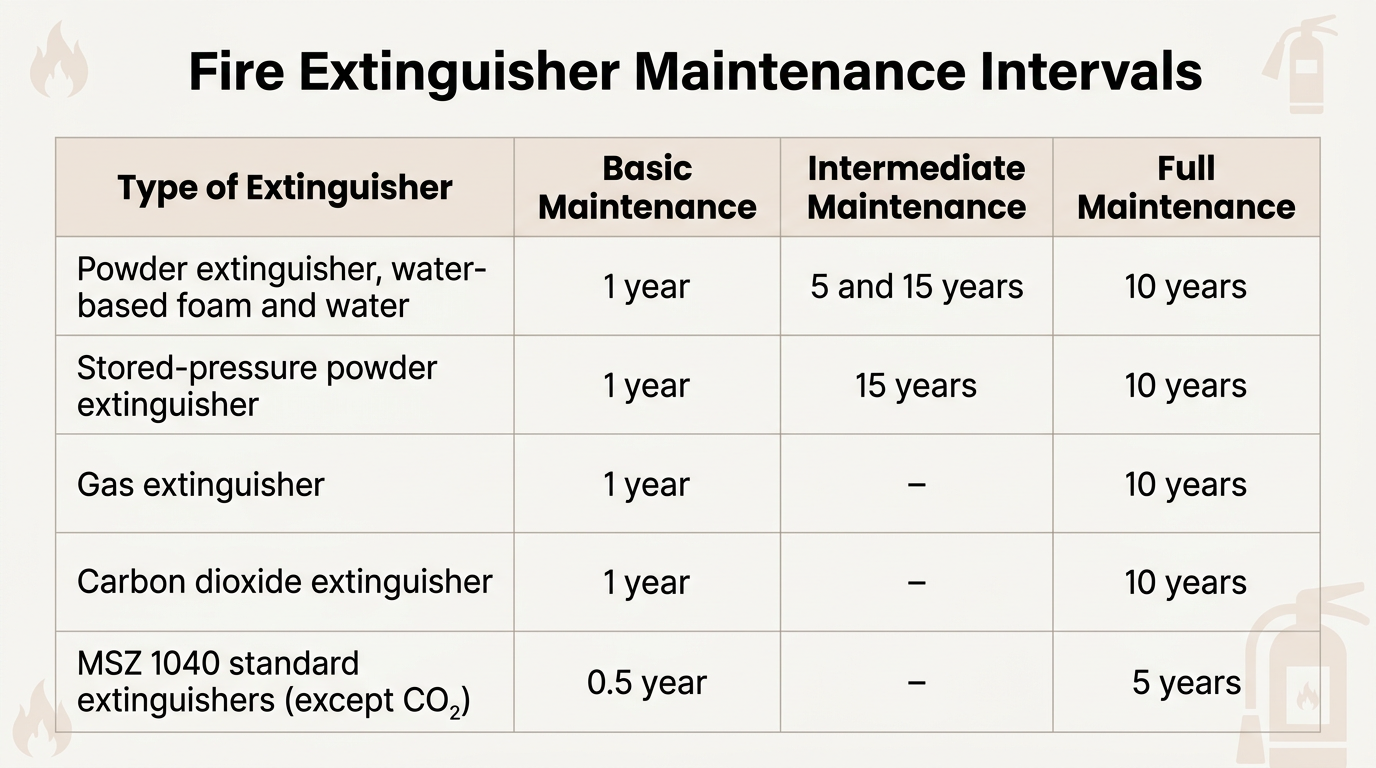
During maintenance, the operator must ensure the required number of extinguishers remains available in the vehicle.
Maintenance services are available nationwide through authorized organizations.
Quality and reliability: don’t cut corners on fire extinguishers
If a vehicle lacks the required extinguisher, authorities may impose fines ranging from 20,000 to 50,000 HUF. Lack of maintenance can result in additional fines between 10,000 and 30,000 HUF.
A fire extinguisher costs only a few thousand forints, yet it ensures safety and helps avoid penalties.
At convoy.hu, you can find high-quality extinguishers from 1 kg to 12 kg that meet all legal requirements.
Although not mandatory for passenger cars, it is still advisable to keep at least a 1 kg extinguisher or spray, as even minor electrical faults can cause fires.