

Staying clean and healthy on the road is harder than it looks. Between recycled aeroplane air, communal handrails, questionable service station bathrooms, and a suitcase that never seems big enough, maintaining good hygiene while travelling takes real planning. Most people either forget something critical or overpack to compensate, ending up with a bag full of half-used products they never needed. This guide cuts through the noise and gives you a practical, evidence-backed hygiene essentials list, whether you’re a solo road warrior, a family of five, or a professional driver clocking long-haul kilometres every week.
Table of Contents
- How to choose your travel hygiene kit: smart criteria
- Core travel hygiene essentials: your must-pack list
- First-aid and medication: stay safe and handle surprises
- Family and child-specific essentials: tailored packing for all ages
- Hygiene in-transit: smart practices for planes, public transport, and remote areas
- The overlooked power of a properly packed hygiene kit
- Travel prepared: explore smart solutions with Convoy
- Frequently asked questions
Key Takeaways
| Point | Details |
|---|---|
| Pack smart, not heavy | Choose compact, travel-size hygiene items that genuinely match your journey’s duration and environment. |
| Hygiene prevents illness | Core essentials like hand sanitiser, wipes, and soap can significantly cut your risk of getting sick on the road. |
| Families need custom kits | Add age-appropriate items such as child-safe medications and calculate nappy needs for travelling with kids. |
| First-aid is essential | Basic first-aid items help you handle minor issues quickly, avoiding unnecessary local medical visits. |
| Apply hygiene everywhere | Use your kit for planes, cars, and remote areas—especially frequent handwashing for maximum protection. |
How to choose your travel hygiene kit: smart criteria
Before you buy or pack anything, it helps to think about your specific journey. A weekend city break calls for something very different from a three-week overland trip with children in tow. Getting this right from the start saves you weight, space, and last-minute stress at the airport.
Start by assessing three things: journey length, mode of transport, and your personal or family needs. A long-haul flight requires different priorities than a road trip through rural areas with limited access to shops or clean water. Families need more variety, while solo travellers can go leaner.
Once you know your needs, look for items that tick these boxes:
- Compact and travel-sized: Anything over 100ml in a carry-on bag creates problems at security.
- Leak-proof: A burst shampoo bottle can ruin everything else in your bag.
- Reusable where possible: Refillable silicone bottles and solid bars reduce waste and save money.
- Multi-purpose: Products like micellar water or antibacterial soap can cover several needs at once.
For air travel, the TSA 3-1-1 rule (which applies similarly at most airports globally) limits liquids to containers of 100ml or less, all fitting in one small clear bag. Switching to solid toiletries such as shampoo bars, toothpaste tablets, or solid deodorant solves this problem entirely. Frequent travellers should maintain a pre-packed kit that is durable and water-resistant, using travel-size or solid bars to comply with 3-1-1 rules and minimise leaks.
For help structuring what goes where, these packing tips for organisation are worth reading before you start filling your bag. You might also find it useful to organise travel essentials using a category-based approach that keeps hygiene items separate from clothing and tech.
Pro Tip: Keep a dedicated, water-resistant pouch pre-packed with your hygiene essentials at all times. When a last-minute trip comes up, you grab it and go rather than starting from scratch.
Core travel hygiene essentials: your must-pack list
With your framework in place, it’s time to fill that kit. These are the items that no traveller should leave without, regardless of destination or trip length.
Core travel hygiene essentials include hand sanitiser, wet wipes, soap or body wash, toothpaste, toothbrush, deodorant, sunscreen, insect repellent, and menstrual products where relevant. Each one earns its place for a specific reason.
- Hand sanitiser (at least 60% alcohol): Your first line of defence when soap and water aren’t available.
- Wet wipes: Good for hands, face, surfaces, and a quick clean-up when showers are scarce.
- Soap or body wash: Liquid or solid, always carry a personal supply rather than relying on accommodation.
- Toothbrush and toothpaste: Pack a spare travel toothbrush in case one gets lost or damaged.
- Deodorant: Solid sticks are easier to pack and last longer than sprays.
- Sunscreen SPF 30 or higher: Non-negotiable for any outdoor travel, even in overcast climates.
- Insect repellent: Essential in tropical or rural destinations where mosquitoes carry disease.
- Menstrual products: Pack more than you think you need since supplies vary wildly by country.
For a quick view of your options, here’s a useful reference:
| Item | Liquid option | Solid/alternative option |
|---|---|---|
| Shampoo | Travel-size bottle | Shampoo bar |
| Toothpaste | Mini tube | Toothpaste tablets |
| Deodorant | Roll-on (under 100ml) | Solid stick or crystal |
| Soap | Body wash bottle | Soap bar |
| Sunscreen | Mini SPF bottle | Sunscreen stick |
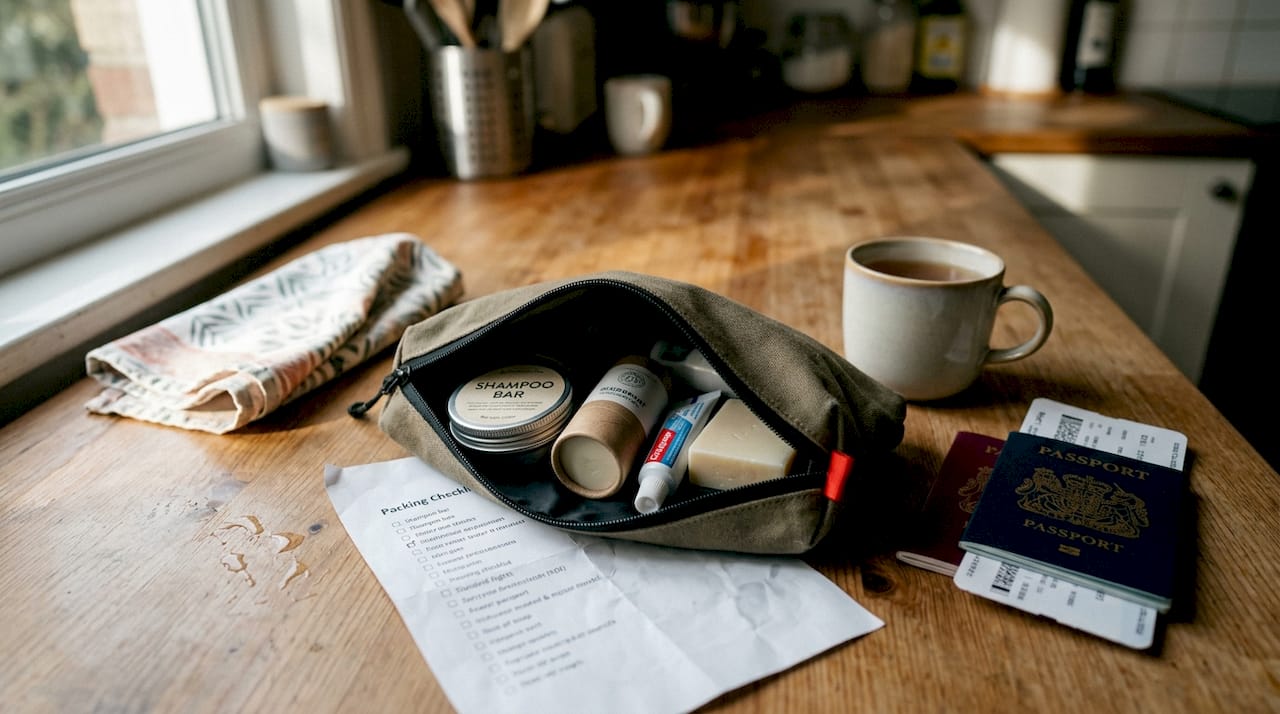
For a broader look at what to bring, the travel accessory essentials guide covers gear that complements your hygiene kit perfectly. Pairing smart products with healthy travel tips means you arrive feeling sharp rather than run down.
First-aid and medication: stay safe and handle surprises
Hygiene essentials keep you clean. First-aid supplies keep you functional when something goes wrong. And on any journey of length, something always goes wrong eventually.
Bandages, antiseptic wipes, hydrocortisone cream, and pain relievers are standard items for managing minor injuries and skin issues during travel. Having these to hand means you handle small problems before they become bigger ones, without needing to find a pharmacy in an unfamiliar city.
Here’s what a solid first-aid kit looks like:
- Adhesive plasters and sterile gauze: For cuts, blisters, and abrasions.
- Antiseptic wipes or cream: Clean wounds to prevent infection.
- Hydrocortisone cream: Soothes insect bites, rashes, and irritated skin.
- Pain relievers (paracetamol or ibuprofen): Handle headaches, fevers, and minor pain.
- Antihistamines: For allergies, hives, or mild allergic reactions.
- Anti-diarrhoeal medication: Essential for international travel where food and water quality varies.
- Motion sickness tablets: Invaluable on winding roads, rough seas, or bumpy flights.
| Basic kit | Enhanced kit |
|---|---|
| Plasters and gauze | All basic items plus rehydration sachets |
| Antiseptic wipes | Prescription medications if applicable |
| Paracetamol | Thermometer |
| Antihistamine | Eye drops |
| Anti-diarrhoeal | Blister treatment pads |
For families on road trips, the road trip safety gear guide expands on what to carry for longer drives with passengers of all ages.
Pro Tip: Use a flat zip case in a different colour from your hygiene pouch to store medications separately. You’ll find what you need faster, especially under stress or in low light.
Family and child-specific essentials: tailored packing for all ages
Travelling with children changes the maths of every packing decision. What works for two adults gets complicated fast when you add a toddler, a school-age child, and a grandparent to the mix.
For families with children, the essentials list expands to include age-appropriate medications, nappies and wipes, and child-safe insect repellents. Infants require exclusive breastfeeding where possible when travelling abroad since it eliminates the need for clean water to prepare formula, reducing infection risk significantly.
Here are three strategies that make family kit assembly far less stressful:
- Build individual pouches per person: Each family member gets their own small pouch with their personal items. This avoids the frantic rummage through a shared bag at the worst moments.
- Pack for the worst-case scenario first: Assume delayed luggage, a long layover, and one unexpected illness. Build from there, then trim what seems excessive.
- Rotate and restock after every trip: Products expire, quantities run low, and children’s sizes change. Doing a kit audit after each journey means you’re always ready for the next one.
“Calculate 8 to 10 nappies per day for infants when packing for travel, adjusting for journey length and access to shops along the route.”
Child-safe insect repellent (DEET-free formulas for young children), age-appropriate pain relievers such as infant paracetamol, and a small supply of rehydration sachets round out the family-specific additions. For more on keeping the whole family comfortable on longer trips, this guide on comfortable family travel covers the full picture.
Hygiene in-transit: smart practices for planes, public transport, and remote areas
Having a well-stocked kit is only half the job. Knowing how and when to use it is what actually keeps you healthy.
On aeroplanes, the risk of illness is real. Using masks, practising hand hygiene, and avoiding contact points such as tray tables, armrests, and lavatory handles reduces both respiratory and contact transmission meaningfully. Cabin air is filtered, but surfaces are not always cleaned between flights.
Here’s the right order of operations for in-transit hygiene:
- Wash hands with soap and water whenever a sink is available, especially before eating.
- Use hand sanitiser (minimum 60% alcohol) when soap is not accessible.
- Wipe down high-contact surfaces (tray tables, seat buckles, touchscreens) with antibacterial wipes before use.
- Avoid touching your face until you’ve cleaned your hands after being in a shared space.
- Wear a mask in crowded or enclosed spaces, especially during peak illness seasons.
Hand hygiene with soap and water or alcohol sanitiser is critical for preventing most travel illnesses, including norovirus, where sanitiser alone may not be effective. This is the most important thing to know: sanitiser is not a complete substitute for proper handwashing.
For remote travel, add water purification tablets or a filter bottle, a mosquito net, and any destination-specific items your research flags. Reviewing the on-the-road hygiene guide gives you a solid grounding in what changes when you’re far from convenient facilities.
The overlooked power of a properly packed hygiene kit
Here’s something most packing guides won’t tell you: a well-built hygiene kit is not just about preventing illness. It’s about reclaiming confidence in situations that feel out of your control.
We’ve spoken with drivers who cover thousands of kilometres a week and families who travel with toddlers across multiple continents. Across the board, the people who travel best are not the ones with the most gear. They’re the ones who know exactly what they have and where it is. That certainty changes how you move through the world.
The counterintuitive truth is that overpacking hygiene products can actually slow you down. A kit crammed with redundant items creates decision fatigue, takes up space, and ironically makes you less prepared because you spend time digging through it instead of acting. Trim your kit to what you genuinely use and trust.
A well-packed kit returns time to you. No scrambling at the pharmacy, no making do, no travelling at less than your best. For smoother travel preparation from the very start, this smoother travel preparation guide is worth bookmarking before your next trip.
Travel prepared: explore smart solutions with Convoy
At Convoy, we’ve been supporting travellers, professional drivers, and families on the road since 1991. We know that the right gear makes the difference between a journey that drains you and one that energises you.
Whether you’re looking for practical Convoy travel solutions to complement your hygiene kit, need reliable tools like a tachograph sender for safe tracking for professional journeys, or want to keep records straight with journey safety charts, we’ve got you covered. Browse our guides and product range to travel with the confidence that comes from being genuinely prepared.
Frequently asked questions
What are the top five travel hygiene essentials?
The top five are hand sanitiser, wet wipes, soap or body wash, toothbrush and toothpaste, and deodorant. These cover the core needs of infection prevention, skin care, and personal freshness on any journey, as recommended for travel kits.
How many nappies should I pack for a baby when travelling?
Pack 8 to 10 nappies per day for infants, then adjust based on your child’s individual habits and how easily you can restock along the route.
Is hand sanitiser alone enough to keep you healthy while travelling?
For most common germs it works well, but for norovirus and certain bacteria, soap and water is more effective and should always be your first choice when available.
Should I include first-aid items in my hygiene kit?
Absolutely. Standard first-aid items such as bandages, antiseptic wipes, and pain relievers are highly recommended for managing minor mishaps before they become serious problems.
What are safe hygiene practices for eating or drinking abroad?
Avoid raw salads, unpeeled fruits, tap water, and ice in destinations where water quality is uncertain. Only use bottled or disinfected water and stick to cooked foods from reputable sources.