

Most travel emergencies don’t happen because of bad luck. They happen because someone assumed they were prepared when they weren’t. Families packing the car, adventure seekers plotting remote routes, and even seasoned drivers often confuse activity with preparation. Grabbing snacks and loading a playlist isn’t a plan. Real preparation spans logistics, health planning, emergency readiness, and tailored safety protocols specific to who’s travelling and where they’re going. Get it right, and the road becomes a genuinely enjoyable place to be.
Table of Contents
- What does travel preparation really mean?
- Health and safety: foundational steps for family travellers
- Building your health risk management plan
- Comparing preparation strategies for solo adventurers and families
- The truth about travel preparation: why most guides miss the mark
- Get prepared with the right safety and comfort gear
- Frequently asked questions
Key Takeaways
| Point | Details |
|---|---|
| Preparation prevents emergencies | Thorough travel planning significantly reduces unexpected risks and makes journeys safer for all. |
| Health and safety come first | Prioritise vehicle restraints, medical access, and insurance to protect your family when travelling. |
| Start health checks early | Book pre-travel health appointments and vaccinations 4–6 weeks in advance for best coverage. |
| Different strategies suit different travellers | Solo adventurers and families need tailored preparation routines. |
| Gear supports your plan | Choosing reliable safety equipment and packing essentials makes each trip more comfortable and secure. |
What does travel preparation really mean?
Travel preparation is one of those phrases people use confidently without fully understanding its scope. Most travellers think it means packing the right bag and knowing the route. In reality, it covers a much wider territory, and the gaps between what people plan and what they actually need are where problems tend to appear.
For road trips and family adventures, preparation involves at least four distinct categories:
- Logistics planning: route mapping, fuel stops, accommodation, and estimated drive times
- Health and medical readiness: vaccinations, prescription medications, first aid, and healthcare access at your destination
- Emergency preparedness: breakdown kits, communication tools, contingency routes, and insurance documentation
- Comfort and wellbeing: rest stop scheduling, child entertainment, sleep gear, and fatigue management
Travel preparation supports health risk management beyond the mechanics of driving, including destination-specific guidance such as planning vaccines and allowing time to complete pre-travel appointments. That’s a point most road trip guides simply skip over, especially for domestic travel where people assume health prep isn’t relevant.
“Preparation isn’t a single task. It’s a layered process that works across safety, comfort, and logistics simultaneously. Miss one layer and the whole structure becomes fragile.”
Good family road trip safety tips always acknowledge this layered approach. Similarly, thoughtful organising of family trips recognises that the emotional and relational dimensions of travel are just as important as the practical ones. Children need predictability. Adults need confidence. Preparation delivers both.
Health and safety: foundational steps for family travellers
Defining preparation is only the first step. The vital part is translating it into actionable safety protocols for your journey, particularly when children are involved.
Pre-travel preparation for families includes planning vehicle restraint use and establishing a clear plan for how to access medical care at each stop. This sounds straightforward, but many families travelling internationally have no idea where the nearest clinic is, whether their travel insurance covers hospital visits abroad, or whether their child’s car seat meets local legal standards.
Here are the core safety steps every family should complete before departure:
- Confirm that all car seats, booster seats, and seatbelts comply with the regulations of every country you’re passing through
- Research paediatric healthcare options at each overnight destination
- Carry copies of each family member’s medical records and prescription details
- Purchase travel health insurance that covers emergency evacuation, hospitalisation, and repatriation
- Pack a dedicated first aid kit with child-appropriate dosages clearly labelled
Pro Tip: Don’t assume your standard car insurance extends to roadside medical assistance abroad. Call your provider and ask specific questions about international coverage before you leave.
The table below outlines the core safety tasks and the ideal timeframe for completing them:
| Preparation task | Recommended timeframe before departure |
|---|---|
| Book pre-travel health appointments | 6 to 8 weeks before |
| Confirm vehicle restraint compliance | 4 weeks before |
| Purchase travel health insurance | 4 weeks before |
| Research medical care at each destination | 2 to 3 weeks before |
| Pack first aid kit and medical documents | 1 week before |
| Confirm emergency contact numbers | 2 to 3 days before |
Families who invest time in planning family road travel consistently report fewer stressful incidents on the road. That’s not coincidence. It’s the direct result of treating preparation as a serious discipline rather than a checklist to rush through the night before departure.
When it comes to packing, having a structured travel gear checklist makes a genuine difference. It removes the guesswork and ensures nothing critical gets left behind. And beyond the checklist, understanding the specific road trip safety essentials for your family’s profile, such as age of children, distance of travel, and destination type, shapes every decision you make.

Building your health risk management plan
With foundational safety in place, it’s time to tackle health risks and destination-specific planning for your trip. This is where many travellers fall short, particularly those who view health planning as something reserved for exotic or long-haul international trips.
Book a pre-travel appointment with a healthcare provider or travel health specialist 4 to 6 weeks before leaving, and bring a copy of immunisation records. This timeline exists for a reason. Certain vaccines require multiple doses spaced weeks apart. Others need time to become effective before exposure. Rushing this process means either skipping essential protection or departing before vaccines take full effect.
Here’s a practical step-by-step guide to building your health risk management plan:
- Identify your destinations: Even a multi-stop European road trip may cross through regions with different health advisories, water quality standards, or insect-borne risks.
- Check official travel health guidance: Government health portals and resources like the CDC provide destination-specific advice updated regularly.
- Book your appointment early: Give yourself 6 to 8 weeks. Bring your existing immunisation records to the appointment so your provider can identify any gaps.
- List all current medications: Confirm you have enough supply for the entire trip plus a buffer. Ask your GP for a letter explaining any controlled medications in case of customs questions.
- Research over-the-counter availability: Some medications common in your home country aren’t available elsewhere. Stock up before you go.
- Document everything: Carry physical copies of immunisation records, prescriptions, and the name of your travel insurance provider. Keep digital backups on your phone.
Pro Tip: Create a single travel health folder, physical and digital, containing every relevant document for every traveller in your group. If someone needs medical care on the road, you’ll be grateful you did this.
Experienced travellers who follow expert packing tips for long journeys know that health documents deserve as much space in your bag as clothing. And every driver should check out a structured driver preparation guide to cover the vehicle-specific side of readiness alongside personal health planning.
Comparing preparation strategies for solo adventurers and families
Whether you’re travelling with family or venturing solo, your approach to preparation will differ significantly. Let’s review the unique needs and strategies for each travel profile.
Pre-trip consultation for families should cover routine logistics such as restraints and vaccination status, plus a concrete medical care plan and insurance considerations. This methodology scales across different family sizes but remains consistently more complex than solo travel simply because more people means more variables.
Here’s a side-by-side comparison of preparation priorities:
| Preparation area | Family travellers | Solo adventurers |
|---|---|---|
| Vehicle safety | Multi-seat restraints, child-safe door locks | Personal restraint, load security |
| Health planning | Paediatric care access, family vaccination records | Personal health checks, travel vaccinations |
| Emergency contacts | Multiple local contacts per destination | Personal emergency contact, local authority numbers |
| Insurance | Family travel health and vehicle cover | Individual travel and vehicle cover |
| Packing approach | Structured family checklist, child-specific items | Lightweight, adaptable personal kit |
| Route planning | Child-friendly stops, accommodation flexibility | Flexible itinerary, self-reliant contingencies |
| Communication tools | Family group plan, child identification items | Personal satellite communicator for remote areas |
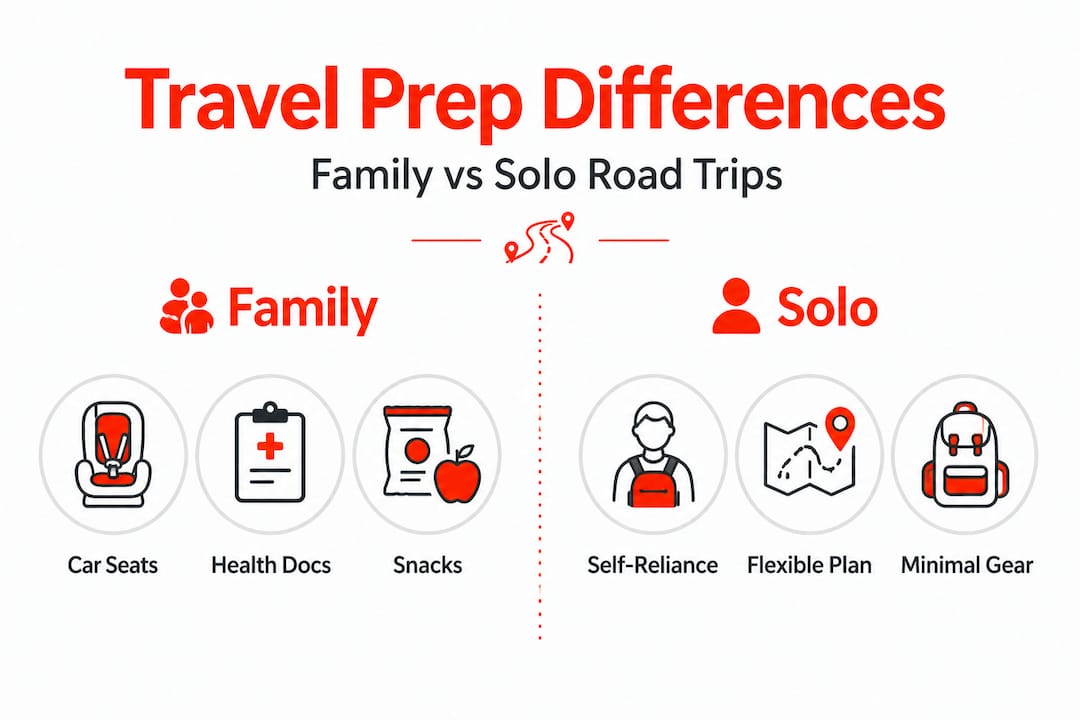
Solo adventurers tend to move faster and with more flexibility, but they carry a different kind of risk: self-reliance without a safety net. If something goes wrong on a remote track, there’s no one to call for help from within the group. That changes the nature of preparation significantly. A solo traveller in a remote area needs satellite communication capability, a detailed personal emergency plan, and the skills to execute it alone.
Families, by contrast, face the challenge of coordination. Everyone’s needs must be anticipated, including sleep schedules for young children, dietary requirements, and the emotional toll of long drives on kids who have limited capacity to simply sit still.
Both profiles benefit enormously from reviewing road trip comfort strategies that address the physical and psychological demands of extended travel. Comfort isn’t a luxury. It’s a safety factor. A fatigued driver is a dangerous driver, and an overstimulated child creates a distracted one.
Some additional considerations that apply to both groups:
- Always carry more water than you think you’ll need, particularly in warm climates or remote areas
- Share your itinerary with someone who isn’t travelling with you and check in regularly
- Know the local emergency number for every country you’re travelling through
- Keep your vehicle’s documentation, including insurance and roadside assistance details, accessible rather than buried in the boot
The truth about travel preparation: why most guides miss the mark
Here’s something worth saying plainly: most travel preparation guides focus almost entirely on gear. What to pack. Which kit to buy. What goes in the boot. And while equipment matters, it’s consistently overemphasised relative to the planning work that actually prevents emergencies.
We’ve spent years helping drivers and families prepare for the road, and the pattern is clear. The travellers who struggle are rarely the ones with the wrong bag. They’re the ones who never researched medical access at their destination, who assumed their insurance covered things it didn’t, or who hadn’t talked through a contingency plan with their travel companions before the moment they needed one.
Preparation is not a checklist. It’s a mindset, and specifically it’s the habit of asking “what happens if?” before you leave rather than after something goes wrong. That question, applied consistently across health, safety, vehicle readiness, and logistics, is what separates genuinely prepared travellers from those who got lucky.
The other mistake? Treating preparation as a one-size-fits-all exercise. A couple on a weekend camping trip and a family of five crossing multiple European borders have entirely different preparation needs. A solo motorcyclist in a remote landscape and a family in a campervan on a coastal route face different risks. Adapting preparation to the actual conditions of your journey, your destination, your passengers, and your own capabilities is what makes it effective.
Exploring content on growing and adapting on the road reveals how experienced travellers continuously refine their approach rather than repeating the same process trip after trip. That adaptability is the real skill. Gear can be replaced. Judgement takes time to develop.
The uncomfortable truth is that most people will not experience a serious emergency on their trip. That success will then reinforce the belief that their existing level of preparation was adequate. It probably wasn’t. It just wasn’t tested. The goal isn’t to prepare for the trips that go well. It’s to be ready for the ones that don’t.
Get prepared with the right safety and comfort gear
Once you appreciate the real-world impact of preparation, finding the right gear becomes the natural next step. Preparation isn’t only about plans and documents. The physical tools you carry on the road make a measurable difference to how safe and comfortable your journey actually is.

At Convoy, we’ve been in the business of equipping travellers since 1991, and we know that the best gear doesn’t just sit in the boot. It gets used, trusted, and relied on when it matters. For visibility and safety in low-light conditions, our reflective safety harness is designed for active use on the road and at rest stops. For travellers tackling rougher terrain, the adjustable safety helmet offers the kind of head protection that adventure seekers shouldn’t leave without. And for those long driving days where practical footwear matters as much as comfort, our camouflage safety shoes are built for exactly that purpose. Explore the full range and take the next step toward a trip you’re genuinely ready for.
Frequently asked questions
What are the first steps to prepare for a road trip with children?
Secure the right restraints for each child, check vaccination status, and establish a clear plan for accessing medical care at your destination. Pre-travel preparation should address vehicle restraint use and a concrete medical access plan from the outset.
How far in advance should travellers book pre-trip health appointments?
You should book a travel health appointment 4 to 6 weeks before departure, as CDC guidance advises this timeframe to allow adequate opportunity for required vaccinations to take effect.
Do solo travellers need a different preparation plan than families?
Yes, solo travellers focus on personal safety, self-reliance, and flexible contingencies, while family preparation must address child restraints, paediatric medical access, vaccination records, and broader insurance considerations.
What documents should you bring for health and safety on an international road trip?
Bring medical records, immunisation certificates, prescription letters, and travel insurance details for all travellers. CDC guidance specifically recommends carrying a copy of immunisation records as part of health risk management for any international journey.