

Travelling with children is one of life’s great adventures, and also one of its greatest tests of patience. The sheer unpredictability of a toddler’s mood, a teenager’s appetite, or a six-year-old’s urgent need for the toilet precisely when you’ve joined a motorway can turn even the most carefully planned trip sideways. But here’s what most families discover after a few journeys: it’s not about eliminating surprises. It’s about building a framework flexible enough to absorb them. This guide covers everything from itinerary planning and smart packing to in-car safety and flying with children, giving you practical strategies that genuinely work.
Table of Contents
- How to plan a flexible and family-friendly itinerary
- Packing essentials for comfort, health, and organisation
- On-the-road safety and comfort strategies
- In-flight and destination success: Hygiene, sleep, and screen balance
- Our perspective: What most travel tip lists miss about family journeys
- Enhance your next family journey with safety and comfort solutions
- Frequently asked questions
Key Takeaways
| Point | Details |
|---|---|
| Flexible planning is key | Adapting schedules and involving children helps reduce stress and improve comfort when travelling as a family. |
| Essentials are a lifesaver | Smart packing—snacks, health kits, clothes—keeps everyone healthy, comfortable, and organised on the go. |
| Safety comes first | Consistent use of age-appropriate car seats and regular travel breaks can prevent common risks for young travellers. |
| Hygiene and routine matter | Maintaining sleep and hygiene habits while in transit and after arrival keeps the whole family well and less stressed. |
How to plan a flexible and family-friendly itinerary
After outlining the central role of preparation, it’s important to begin with building a family-centred travel plan. The biggest mistake most families make is over-scheduling. You arrive somewhere beautiful, you want to see everything, and before lunch the children are overtired and everyone is irritable. Fewer activities, with generous time built around each one, consistently produces happier trips than ambitious to-do lists.
A good starting point is matching your daily schedule to your children’s ages and energy patterns. Toddlers nap. Older children hit walls mid-afternoon. Plan flexible schedules that account for rest time, and you’ll find the whole family has more genuine energy for the moments that matter. A morning activity followed by a relaxed lunch and unstructured afternoon time is often far more enjoyable than back-to-back sightseeing.
Involving children in the planning process is not just a nice idea — it’s a practical one. Research confirms that when you involve kids in planning and talk openly about the trip beforehand, anxiety reduces and excitement builds. Ask your children what they most want to do. Let them choose between two options, rather than presenting an open-ended blank slate, which can feel overwhelming. This small shift in approach gives children a sense of ownership without putting an unfair planning burden on them.
Here are some additional strategies worth building into your pre-trip conversations:
- Walk children through what the journey will look and feel like, step by step
- Show them photos or videos of your destination so it feels familiar before you arrive
- Discuss what happens at airports, motorway services, or border crossings in advance
- Carry recent photographs of your children in your bag in case of separation in busy locations
- Assign older children simple responsibilities, such as carrying their own small rucksack or holding the map
When it comes to organising family trips, the most experienced travelling families lean on simple rules rather than rigid plans. One of the most effective is the “one big thing” approach.
“The goal of family travel is not to see the most things. It’s to enjoy the experience of seeing some things together, without everyone arriving home more exhausted than when you left.”
Pro Tip: Adopt the “one big thing” rule. Plan one meaningful activity per day, and keep afternoons deliberately unscheduled. This single habit reduces meltdowns, allows for spontaneous discovery, and genuinely improves the quality of your family’s shared experience.
Packing essentials for comfort, health, and organisation
Once a flexible plan is in place, having the right supplies on hand becomes the next priority. Packing for a family is an art form. Pack too little and you’re scrambling in unfamiliar places for basic supplies. Pack too much and you’re wrestling with oversized bags at every turn. The goal is a system, not just a list.
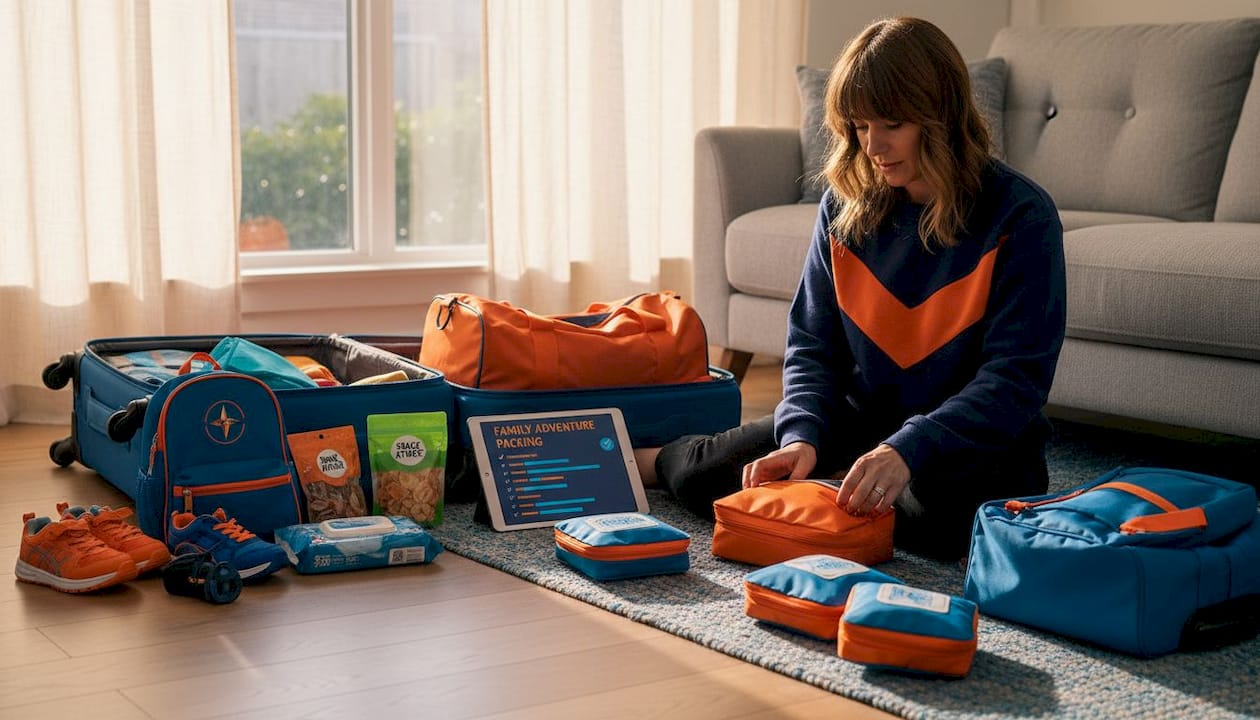
The foundation of smart packing for family travel is separating your essentials from your extras. Essentials are things you genuinely cannot do without for 24 hours: nappies, medicines, a change of clothes, food, and hydration. Everything else is an extra. Keep essentials in your carry-on or the most accessible bag regardless of your mode of transport.
Here’s a practical checklist to work from:
- Snacks and hydration: Healthy non-perishable options such as oat bars, dried fruit, and crackers. Refillable water bottles for every family member
- Clothing: One change of clothes per child in a resealable bag, plus an extra layer for all travellers
- Wipes and tissues: Non-negotiable, in quantities that feel excessive until the moment they’re not
- Medicines: Children’s paracetamol, antihistamine, plasters, thermometer, and any prescribed medications
- Health kit: Pack sunscreen, insect repellent and hand sanitiser within easy reach, not buried at the bottom of a suitcase
- Entertainment: Small toys, colouring books, sticker sets, and headphones for each child
The resealable bag strategy is one of the most underused tricks in family packing. Pack a change of clothes for each child in a separate resealable bag. If there’s a spill or an accident, the soiled clothing goes into the same bag and it seals in the mess. No cross-contamination, no drama.
For expert packing tips that go beyond the basics, consider investing in packing cubes and labelled pouches. Organisation systems that work at home tend to collapse on the road unless they’re built for portability.
| Item category | Road trip priority | Flight priority |
|---|---|---|
| Snacks and water | Essential | Essential |
| Car seat or travel booster | Essential | Check airline policy |
| Change of clothes (resealable bag) | Essential | Essential |
| Health and medicine kit | High | High |
| Entertainment pack | High | High |
| Hygiene essentials | High | High (100ml limits apply) |
| Sunscreen and insect repellent | High | Medium |
| Travel pillow or blanket | Medium | High |
Pro Tip: Colour-code bags for each child. Assign one colour per child and stick to it across all their items. Blue water bottle, blue rucksack, blue packing cube. When you’re trying to locate something quickly in a busy airport or at a rest stop, this system saves significant time and reduces the chance of anything being left behind.
On-the-road safety and comfort strategies
With essentials packed, focus shifts to what keeps children safe and content during the journey itself. Road trips with children require a different kind of planning than solo or adult-only driving. The vehicle becomes a temporary living space, and the decisions you make about safety, scheduling, and comfort inside it directly affect the quality of the whole trip.
Car seat safety is non-negotiable and worth revisiting before every trip. Use age-appropriate car seats: rear-facing for infants and young toddlers, forward-facing as long as the seat allows, then a high-back booster until your child reaches approximately 4 feet 9 inches in height. If you’re hiring a car abroad or flying with a car seat, check airline policies in advance. Not all airlines accept all seat models, and some destinations have different regulations.
Here is a practical step-by-step road trip safety plan:
- Before departure: Inspect the car seat installation, check tyre pressure, and ensure the emergency kit is accessible
- Every two hours: Stop for breaks to let children stretch, use the toilet, and reset before restlessness peaks
- During stops: Never leave children unattended in the vehicle, particularly in warm weather, where temperatures inside a parked car rise dangerously within minutes
- Snack timing: Offer food and water at stops rather than in continuous motion to reduce mess and choking risk
- Evening planning: Aim to arrive at your overnight destination before children’s usual bedtime to maintain routine
| Car seat type | Age or size range | Road use | Air travel |
|---|---|---|---|
| Rear-facing infant seat | Birth to approx. 12 months | Essential | Check airline |
| Rear-facing convertible seat | Up to approx. 2 to 4 years | Recommended | Check airline |
| Forward-facing with harness | Approx. 2 to 7 years | Essential | Check airline |
| High-back booster seat | Approx. 4 to 10 years | Essential | Rarely accepted |
| Backless booster | Until 4’9" height | Appropriate | Not suitable |
Exploring road trip safety gear before a long journey is a worthwhile investment. Organisers, headrest mounts, and sunshades all contribute to a more comfortable and safer driving environment. For those tackling substantial distances, long-distance driving safety advice for adults is equally important, since a fatigued driver is the most significant risk on any family road trip.
Snack timing matters more than most parents realise. Hunger is one of the most predictable triggers for travel meltdowns. Offer a small snack every 90 minutes to two hours rather than waiting for children to ask, and you’ll notice a significant improvement in overall mood during long stretches.
In-flight and destination success: Hygiene, sleep, and screen balance
Beyond the road, flying and settling into new places require their own expert guidance. Air travel with children presents a specific combination of logistical, physical, and emotional challenges. Get the basics right, and the experience becomes manageable. Rush it or underestimate it, and even a short flight can feel like an ordeal.
Arrive early. This advice sounds obvious but it’s routinely underestimated. Arrive extra early for security so you have time to prepare children for the process. Explain that bags go through a machine, that adults step through a scanner, and that shoes might need to come off. Children who know what to expect move through security calmly. Children who don’t often freeze, which creates pressure for everyone.
Once on board, prioritise hygiene immediately. Disinfect tray tables and armrests with antibacterial wipes as soon as you sit down. Alert airlines to any food allergies during booking and again at check-in. Maintaining your child’s usual routines for mealtimes and sleep while in transit helps the body adapt, particularly across time zones.
Here are the most important dos and don’ts for flying with kids:
- Do use a dummy or breastfeed during take-off and landing to ease ear pressure for infants
- Do pack a dedicated in-flight bag with entertainment, snacks, and comfort items
- Do walk the aisle with restless toddlers rather than forcing them to sit still
- Do request a bulkhead seat or bassinet row at booking for families with infants
- Don’t rely entirely on screens for entertainment. Prioritise drawing, small toys, sticker books, and audiobooks first
- Don’t skip the pre-flight toilet stop, even if children insist they don’t need to go
- Don’t pack liquids for the health kit that exceed the 100ml carry-on restriction
Research consistently points to jet lag as an underestimated challenge for travelling families. Adjusting children’s sleep schedules by 30 minutes per day in the two to three days before departure can significantly ease the transition. Post-arrival, exposure to natural daylight at the destination’s local morning time is among the most effective tools for resetting the body clock quickly.
Pro Tip: Use screens as a genuine last resort rather than the first response to boredom. Children who exhaust the low-tech options first, drawing, storytelling, audiobooks, small puzzles, tend to settle into screens more quietly when you do offer them, and the transition back off screens at the destination is much smoother.
Our perspective: What most travel tip lists miss about family journeys
Most travel advice for families focuses on what to pack or where to go. Very little of it addresses the mindset that actually determines whether a family trip succeeds or fails. The families who consistently report enjoying their travels are not the ones with the best gear or the most meticulously planned itineraries. They’re the ones who’ve accepted that something will go wrong, and have built their trip around that reality rather than against it.
There’s a real tendency to treat travel as a performance: be in the right place at the right time, take the right photos, and return having ticked the right boxes. That approach produces stress, not memories. The most meaningful travel moments for children tend to be unexpected ones. The unplanned stop at a strange roadside café. The afternoon lost in a park because the museum was shut. The delayed flight that led to an hour of card games in the terminal.
Cutting travel stress often has less to do with logistics and more to do with expectations. When you plan for flexibility rather than perfection, and when you invite children into the process as genuine participants rather than passengers, the dynamic of the whole trip shifts. The packing systems matter. The safety gear matters. But the willingness to adapt, to laugh at chaos and find the story in it, is what families actually remember years later.
Enhance your next family journey with safety and comfort solutions
If you’re ready to put these strategies into action on your family’s next adventure, the right gear makes a meaningful difference.

At Convoy, we’ve been supporting travelling families since 1991, and we understand the difference between gear that looks useful and gear that genuinely performs on the road. From high-visibility safety essentials to practical organisers and comfort solutions built for long journeys, our range is designed around the realities of family travel. Whether you’re planning a weekend road trip or a longer European adventure, browse our curated selection of family travel safety gear and find the solutions that support every stage of your journey, from the first motorway mile to the final destination.
Frequently asked questions
How do I keep children entertained during long car journeys?
Mix low-tech activities such as audiobooks, drawing, and small puzzles with screens as a last resort to keep children engaged without building an over-reliance on devices.
What are the best snacks to pack for family travel?
Choose non-perishable, healthy snacks such as dried fruit, crackers, and oat bars. Pack these essentials in your carry-on or most accessible bag to prevent hunger and keep moods stable during travel.
How often should we take breaks on a road trip with kids?
Stop every two hours on road trips to let children stretch and reset, which significantly reduces restlessness and improves overall comfort for everyone in the vehicle.
How do I help children cope with jet lag when travelling?
Adjust your child’s sleep schedule gradually in the two to three days before departure, and after arrival expose them to daylight during local morning hours to help reset their body clock efficiently.